DOCENDO DISCIMUS

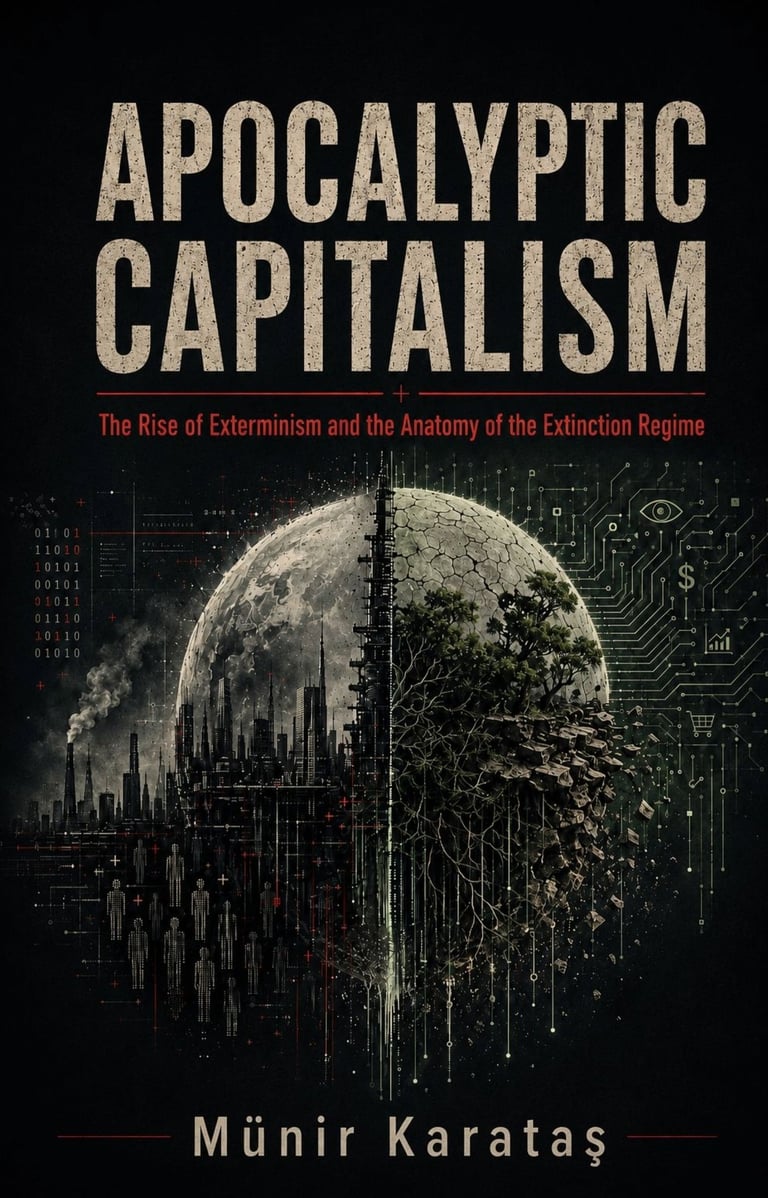
APOCALYPTIC CAPITALISM
The Rise of Exterminism and the Anatomy of the Extinction Regime
"What we call progress is quietly constructing the architecture of our own extinction."
You wake up. You reach for your phone. Before you've spoken a word, algorithms have already mapped your fears, predicted your desires, and sold them back to you. This is not surveillance. This is ownership — of your attention, your behavior, your future.
Apocalyptic Capitalism argues that the crises of our age — digital surveillance, ecological collapse, biotechnological inequality, the erosion of democracy — are not separate emergencies. They are a single system, operating by a single logic. Drawing on E. P. Thompson's concept of exterminism, Münir Karataş offers a structural anatomy of a civilization that has begun engineering its own end.
This is not a book about what might go wrong. It is a book about what is already underway.
From IBM's punch cards in Nazi Germany to China's social credit system; from Silicon Valley's bunkers to the biotech dreams of immortality reserved only for the wealthy. Karataş traces the arc of a new caste order built on data, code, and manufactured scarcity. He shows how capitalism no longer merely exploits labor. It now claims ownership over the body, the mind, and the genetic code itself.
Yet Apocalyptic Capitalism is not a book of resignation.
Revisiting Marx through the lens of data labor, the attention economy, and algorithmic governance, Karataş maps the terrain of resistance: open-source ecosystems, ecological commons, the politics of collective intelligence. Drawing on deep ecology, indigenous knowledge systems, and posthumanist ethics, he argues that another configuration of human technology nature relations is not only imaginable — it is necessary.
The darkness of our time is real. But it has not yet had the final word.
For readers of Shoshana Zuboff, Byung-Chul Han, and Nick Srnicek.